
Every Engineering manager knows the feeling: you wake up already juggling a thousand thoughts, your calendar is a battlefield, and Slack notifications seem endless. It’s a chaotic yet rewarding role, one where the pressure to deliver is only rivaled by the satisfaction of seeing your team succeed.
In 2024, my days as an Engineering manager (EM) were a constant balancing act. I want to share what those days looked like, the challenges I faced, and how I’ve since discovered a helpful framework for managing time better in Aviv Ben-Yosef’s “The Tech Executive Operating System” book.
My typical day as an EM in 2024
Starting up
My mornings started with a nearly automatic ritual: scanning Slack for anything urgent, skimming overnight emails, and reviewing updates in key Confluence spaces. This prep time was a chance to organize my thoughts before the barrage of meetings and tasks that awaited me.
Core responsibilities

The bulk of my day revolved around people and priorities. Mornings typically included a few one-on-one meetings with engineers, product managers, or other stakeholders. These touchpoints helped unblock progress, align on goals, address morale, and maintain a clear understanding of the bigger picture.
Afternoons often featured cross-functional meetings like collaborations with Product and teams from another business vertical or discussions with leadership to realign on broader company visions. Occasional sync meetings with my manager helped bridge the gap between immediate team concerns and the bigger business and department strategy.
Administrative work
Sprinkled throughout the day were the operational essentials:
- sprint planning prep: collaborating with the Product Owner on backlog grooming (or refinement)
- preparing for retrospectives – ranging from setting up a clean board using a template to gathering input from colleagues across teams ahead of the meeting.
- syncing with peer teams to understand their progress, coordinate efforts, and prevent rework or last-minute surprises near release
- crafting various reports for upper management, often tailored to different needs
While necessary, this work was often squeezed between pressing conversations and unexpected “fires to fight”.
End of the day
As the day wound down, I reflected on my progress and prepared for the next day. Carving out focused time wasn’t always easy, as urgent tasks often expanded to consume the day’s remainder.
Still, ending with a moment of clarity was critical for staying grounded.
Time distribution
Here’s a breakdown of my time during a typical workday in 2024:
- One-on-ones: 25–35%
- Meetings with peers and stakeholders who weren’t directly in the team: up to 50%
- Email and Slack: 5–15%
- Putting out fires: 5–20%
- Recruitment: 0–60% (depending on the quarter)
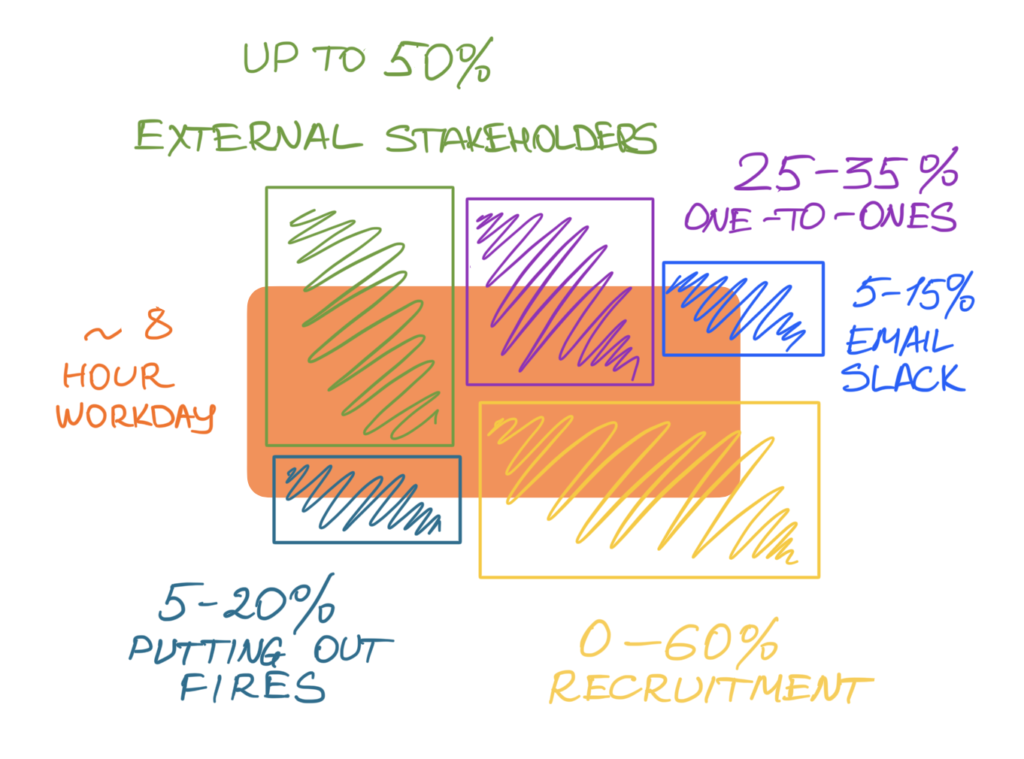
Although the upper limits amounted to 160%, or 12.8 working hours, this was never actually the case in practice. For instance, Mondays typically involved fewer 1-on-1s, and recruitment demands decreased or became unnecessary later in the year.

The challenges of 2024
Despite the rewarding nature of the role, I often felt reactive rather than proactive. My calendar was a constant reminder that I wasn’t setting aside enough time for deep work or strategic thinking.
For instance, there were several weeks of adjustment as the company navigated a significant pivot. My team needed clarity, my leadership expected quick answers, and my own priorities were sidelined. It was a reminder of how difficult it is to balance short-term firefighting with long-term team development.
Installing “The tech executive operating system”

Aviv Ben-Yosef’s “The Tech Executive Operating System” book offers a comprehensive guide to navigating the world of technical leadership. Among its many valuable insights, one topic stands out: time management. The book emphasizes that effective leadership isn’t about filling your calendar − it’s about using your time to create impact.
One of the valuable recommendations is a strategy for distributing your time across competing demands to maximize your return on (time) investment.

I found the time distribution approach proposed in the book quite insightful. It emphasizes allocating time intentionally to activities that create the most value. Depending on your routine, it might take some effort to put into practice, but it seems like it could pay off nicely.
The book also introduces a practical framework for tracking progress, identifying busy work, and ensuring that your efforts align with high-impact goals. By applying these principles, leaders can elevate their R&D teams, transforming them from perceived cost centers into innovation engines.
“It might come as a surprise, but the best leaders I’ve worked with, in all types of executive roles, are not always busy. They have time to chat in the office. Grabbing them for a few minutes isn’t something that requires a week’s notice. They are responsive.” - excerpt from the book.
This book is concise and so packed with good advice that you can almost hear it crackle on a silent evening.
My plan for 2025
For 2025, my goal is to be more intentional about how I allocate time and actively track the impact of those activities. Inspired by the framework in the book, I want to ensure my schedule aligns more closely with the suggested approach while adjusting it to what my role requires.
Let’s meet on this blog closer to next year’s end to review what actually happened!
Summary

Being a technical lead or manager means constantly juggling priorities. Still, without intentional time management, it’s easy to lose sight of what matters most. Reflecting on my 2024 experience and incorporating insights shared by Aviv Ben-Yosef has been an energizing experience!
I suggest getting a copy of the book and going through it while reflecting on your own recent experience.
Are you spending your time where it counts? The answers might change the way you lead.
Links and resources
- The Tech Executive Operating System book on Goodreads: https://www.goodreads.com/book/show/56365371-the-tech-executive-operating-system
- The Engineering manager role explained (on this blog): https://igortkanov.com/the-engineering-manager-role-explained/